
No products in the cart.
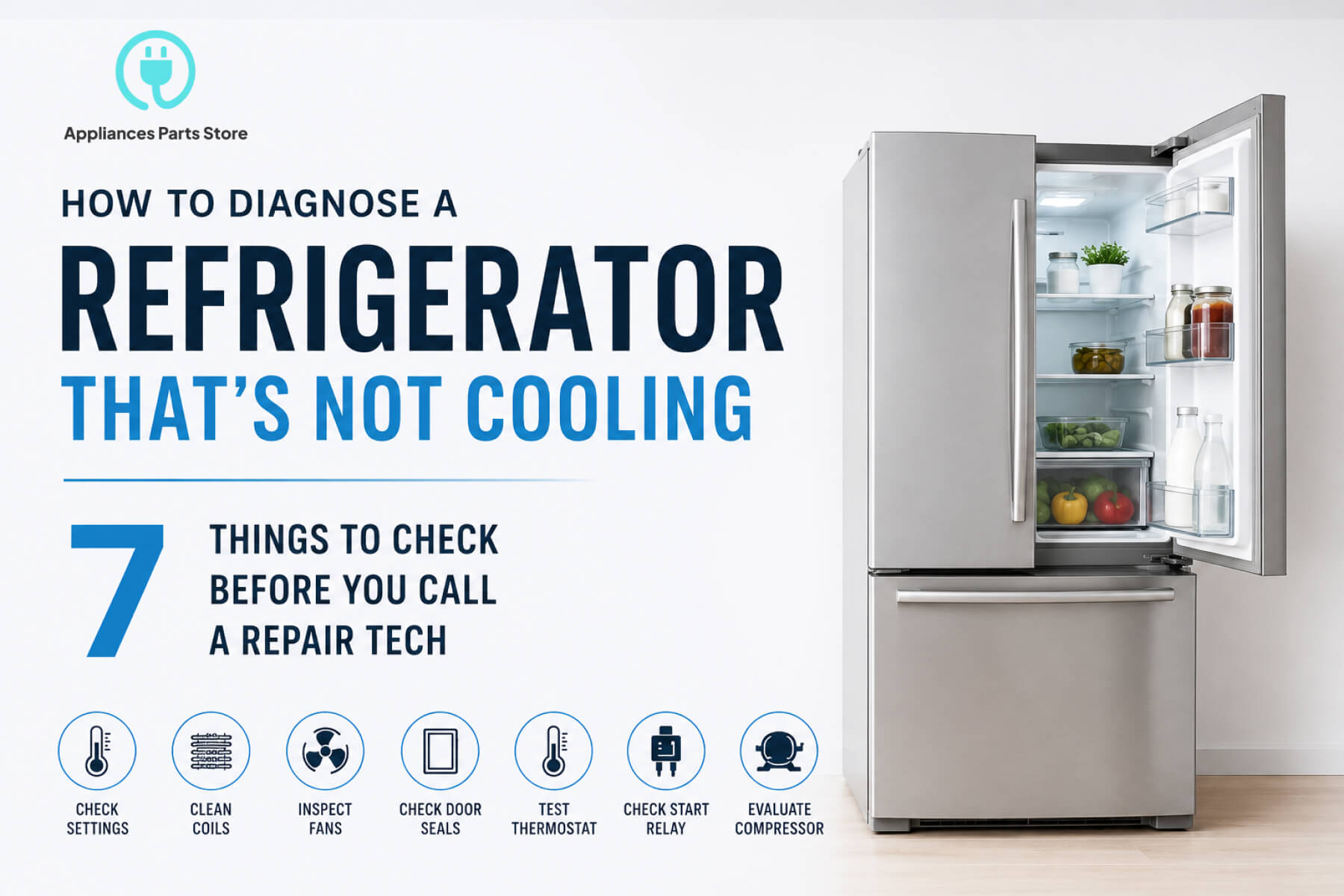
How to Diagnose a Refrigerator That’s Not Cooling: 7 Things to Check Before You Call a Repair Tech
A warm refrigerator is one of the most stressful appliance problems, because every hour you wait, food spoils. The good news: most cooling failures trace back to one of a handful of parts, and you can usually pinpoint the cause in under 20 minutes with no tools beyond a flashlight and a vacuum. Below are the seven checks a repair technician would run first, in the order they’d run them, so you can decide whether this is a 10 minute DIY fix or a job for a pro.
1. Confirm It's Actually a Power or Setting Issue
Before touching any part, rule out the simple stuff. Check that the unit is fully plugged in, the outlet has power (test it with another device), and the temperature dial hasn’t been bumped to a warmer setting or accidentally switched to “off” or “vacation mode.” If you recently moved the fridge to clean behind it, this is the single most common cause of a “broken” fridge that isn’t broken at all.
2. Inspect and Clean the Condenser Coils
The condenser coils release the heat pulled out of your food compartment. When they’re coated in dust, pet hair, or grease, the fridge can’t shed heat efficiently and cooling drops off gradually rather than all at once. Coils sit either behind a rear panel or underneath a front kick plate.
Pull the fridge from the wall (or remove the front grille), and vacuum the coils with a brush attachment or a dedicated coil-cleaning brush. This single fix resolves a surprising share of “not cooling” complaints and costs nothing.
3. Test the Condenser Fan Motor
Next to the coils, you’ll usually find a small fan that pulls air across them. If this condenser fan motor has seized, is unplugged, or has a worn bearing, the coils can’t cool even if they’re spotless. With the fridge unplugged, spin the fan blade by hand. It should turn freely and smoothly. Grinding, wobbling, or a fan that won’t turn at all points to a failed motor that needs replacing.
4. Check the Evaporator Fan and Coils
If your freezer is cold but the fridge compartment is warm, the culprit is often in the evaporator section behind the freezer’s rear panel. This is where cold air is generated and pushed into the refrigerator side. Two things go wrong here:
- Frost buildup on the evaporator coils (usually from a failed defrost system), which blocks airflow entirely.
- A failed evaporator fan, which stops circulating the cold air into the fridge compartment.
5. Examine the Door Seals (Gaskets)
A worn or torn door gasket lets warm room air leak in continuously, forcing the compressor to run constantly without ever reaching the set temperature. Close the door on a piece of paper or a dollar bill: if you can pull it out with no resistance, the seal isn’t gripping properly. Also run your hand around the door edge feeling for warm spots, cracks, or areas where the gasket has come loose from the door liner.
6. Listen for the Compressor and Test the Start Relay
The compressor is the heart of the cooling system, and it’s usually the last thing to suspect, not the first, since it fails far less often than fans, coils, or gaskets. Pull the fridge out and listen: you should hear a low hum when it’s running. If you hear clicking every few minutes but no hum, the start relay (a small component next to the compressor) may be failing to kick the compressor into gear. Start relays are inexpensive and one of the more common causes of a compressor that “won’t start” even though it’s mechanically fine.
If there’s no sound at all and you’ve confirmed power is reaching the unit, the compressor itself may have failed, this is the one repair on this list where calling a licensed technician usually makes more sense than a DIY swap, since it involves the sealed refrigerant system.
7. Check the Thermostat and Temperature Control Board
If everything above checks out but the fridge still won’t hold temperature, the temperature control thermostat may be misreading the internal temperature and failing to signal the compressor and fans to run. On older mechanical models this is a simple dial-style thermostat; on newer models it may be an electronic control board. A thermostat that’s stuck open won’t call for cooling at all, while one that’s stuck closed can cause the opposite problem, over-freezing food in the fridge compartment.
Quick Diagnostic Summary
| Symptom | Most Likely Part |
|---|---|
| Both compartments warm, compressor silent | Start relay or compressor |
| Freezer cold, fridge warm | Evaporator fan or frost buildup |
| Gradual warming over days | Dirty condenser coils |
| Warm spots near the door | Door gasket |
| Fridge runs constantly, never reaches temp | Door gasket or thermostat |
| No cooling anywhere, unit runs fine | Thermostat or control board |
Frequently Asked Questions
Why is my freezer cold but my refrigerator isn't cooling?
This almost always points to airflow between the two compartments, either a failed evaporator fan that isn’t pushing cold air into the fridge, or frost buildup on the evaporator coils blocking that airflow.
How much does it cost to fix a refrigerator that's not cooling?
DIY parts like a condenser fan motor, start relay, or door gasket typically run far less than a technician’s service call, which often starts at $100-$150 before parts. Diagnosing the exact part yourself can cut the total repair cost significantly.
Can dirty condenser coils really stop a fridge from cooling?
Yes. Coils caked in dust and pet hair can’t release heat efficiently, which makes the compressor work harder and, over time, causes the whole unit to lose its ability to keep up with cooling demand.
How do I know if it's the compressor and not something else?
Check every other component first, coils, fans, gaskets, thermostat, and start relay, since compressor failure is the least common cause. A compressor that hums quietly but never cools, or one that’s silent despite confirmed power, are the strongest signs it’s the compressor itself.
Is it safe to replace refrigerator parts myself?
Fans, gaskets, thermostats, and start relays are beginner-friendly repairs that just require unplugging the unit first. Anything involving the sealed refrigerant system, meaning the compressor or refrigerant lines, should be left to a licensed technician.