No products in the cart.
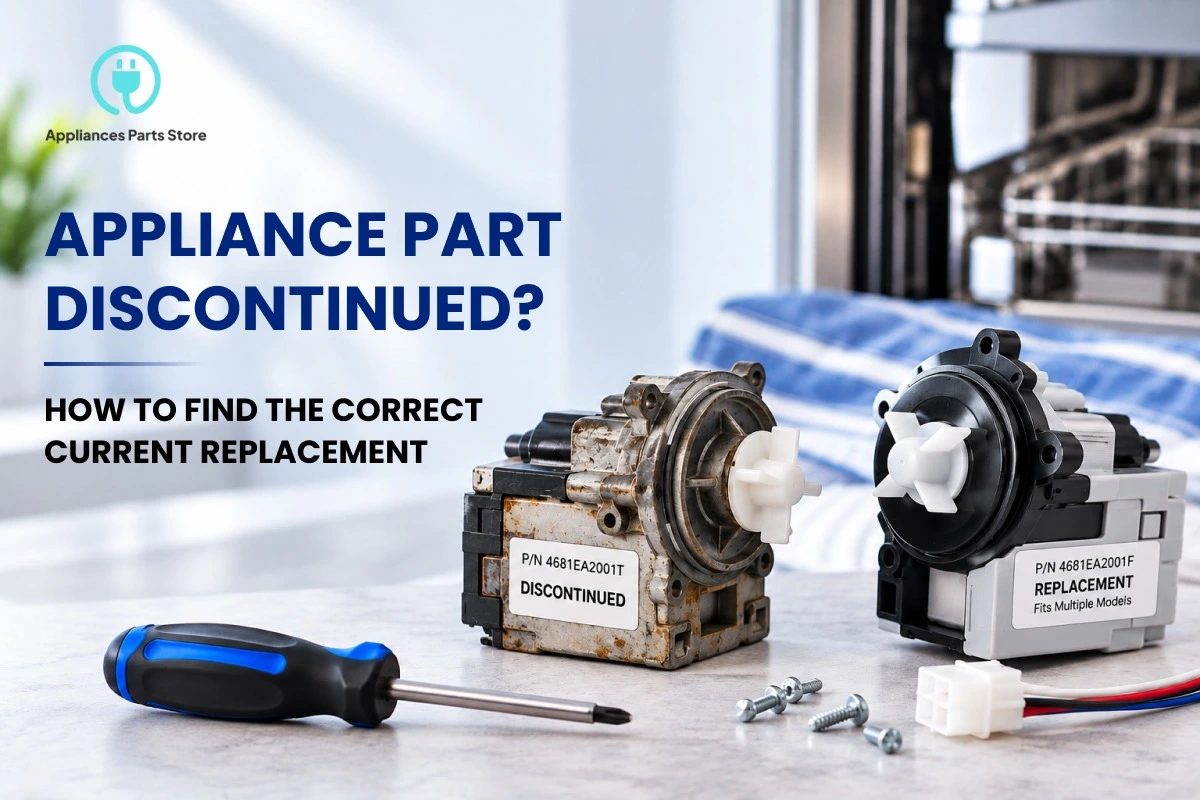
Appliance Part Discontinued? How to Find the Correct Current Replacement
If the exact part you need has been discontinued, you’re not out of options, but you do need to verify carefully before you buy. Manufacturers often list a “superseded” or “replacement” part number for something they’ve stopped making, and that number isn’t always right. Here’s how to find the actual current equivalent, confirm it fits before you install it, and what to do if nothing new exists at all.
Why Parts Get Discontinued
Manufacturers retire older part numbers as models age out, designs change, or a component gets redesigned and folded into a newer version. This is normal, and it doesn’t mean your appliance can’t be fixed, it just means the search takes one extra step.
How to Find the Current Replacement
- Get your appliance’s full model number, not just the part number you’re trying to replace.
- Search your part number directly. Most parts catalogs will flag it as discontinued and show a “replaces” or “superseded by” number if one exists.
- Don’t stop at the first number you’re given. Cross-check it against your specific model. A superseded part is sometimes designed to cover a whole range of models and doesn’t always fit every one of them identically.
- Compare physical details before installing: mounting hole pattern, connector type and pin count, and overall dimensions, not just the part’s general description.
- If no superseded number exists, look for a verified compatible aftermarket equivalent, or a used or refurbished original.
Have your model and part number ready?
What to Do If the "Replacement" Doesn't Actually Fit
This happens more often than people expect. If a listed supersession doesn’t line up, wrong mounting holes, a mismatched connector, don’t force it. Go back to your model number instead of the old part number and search from there. A model-based search sometimes surfaces the correct current part even when the part-to-part supersession chain has an error in it.
When There's No Direct Replacement at All
You still have options: a used or refurbished OEM part from a seller who tests it and offers a return policy, a verified aftermarket equivalent, or for boards and modules, a repair or rebuild service if the failure is a known, fixable fault rather than the whole unit failing outright. Weigh the part’s cost against how much life is realistically left in the rest of the appliance before sinking money into an increasingly rare part.
Is It Still Worth Repairing at This Point?
For a cheap, available part, almost always yes. For a genuinely hard-to-find part on an aging appliance, compare its cost, even at a premium, against a full replacement unit. If it’s still a small fraction of a new appliance’s price, repair usually wins.
Can't find your part listed?
Frequently Asked Questions
How do I know if my part number has a replacement?
Search the part number directly. Most parts catalogs will flag it as discontinued and list a superseded number if one exists.
Does a superseded part number always fit my exact model?
Not always. Supersessions sometimes cover a range of models, so always verify against your specific model number before installing.
What if the replacement part doesn't physically fit?
Compare mounting holes, connector type, and dimensions before installing. If it doesn’t match, search by your model number again rather than trusting the part-to-part chain.
Can I use a used or refurbished part instead?
Yes, for many components, as long as the seller tests it and offers a return policy. It’s a reasonable option when no new equivalent exists.
At what point should I stop chasing a discontinued part?
When the part’s cost, especially at a premium price, starts approaching a meaningful fraction of a new appliance’s price. That’s usually the point to compare repair against replacement.