No products in the cart.
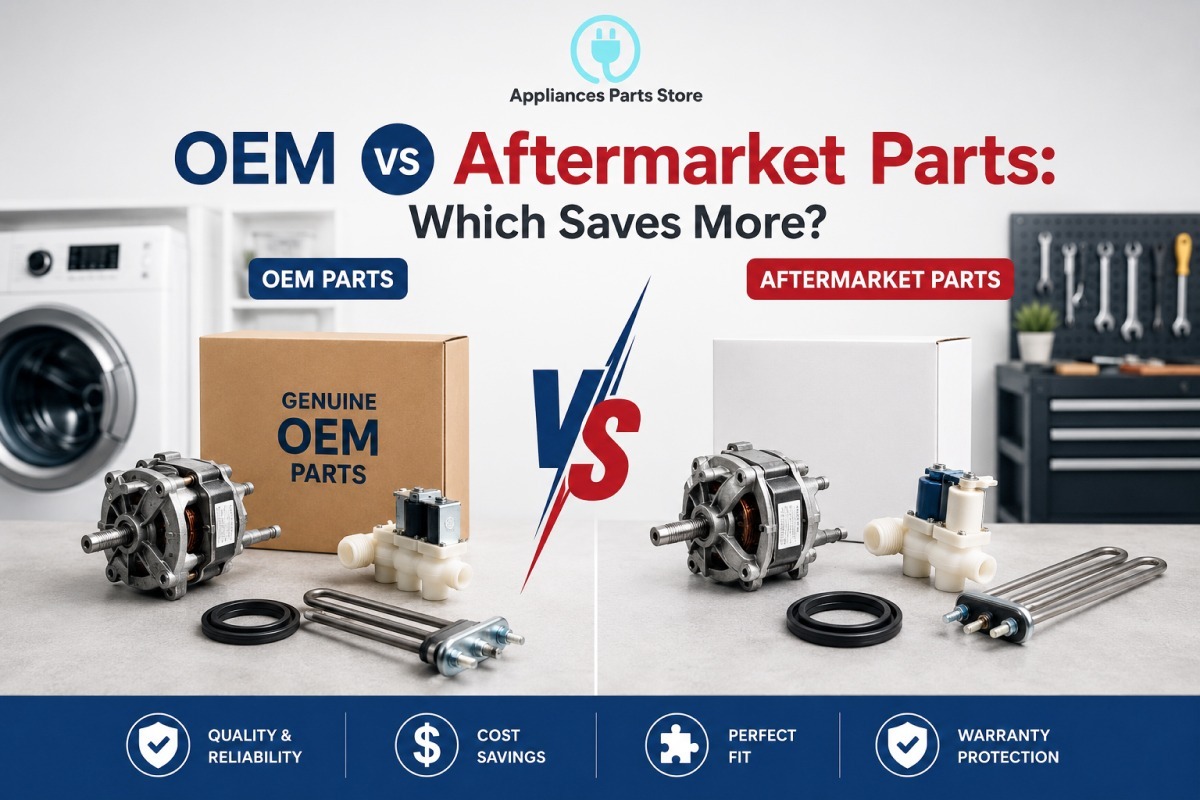
OEM vs Aftermarket Appliance Parts: The Complete Decision Matrix for 2026
Your washer is leaking. You search the part online and find two options: the OEM part for $89 and an aftermarket version for $34. They look identical in the photos. You add the cheaper one to your cart, then pause.
That hesitation is smart. The wrong choice doesn’t just waste $34. It can damage your refrigerator, dryer, or dishwasher, void your warranty, and cost you hundreds in repeat repairs.
This guide gives you a clear, part-by-part decision matrix so you never second-guess again, whether you’re shopping for washer parts, oven parts, or refrigerator parts.
What Does OEM Actually Mean?
OEM stands for Original Equipment Manufacturer. An OEM part is made by the same company that built your appliance, or by a factory that meets their exact engineering specifications.
When your Whirlpool dryer rolled off the line, it came with an OEM heating element. The OEM replacement is that same element. Same wattage. Same dimensions. Same materials.
Key OEM characteristics:
- Manufactured to the original design specifications
- Tested within the complete appliance assembly
- Carries the brand’s part number and packaging
- Backed by the manufacturer’s warranty (typically 90 days to 1 year)
What Are Aftermarket Parts?
Aftermarket parts, also called generic, compatible, or third-party, are made by companies other than the appliance manufacturer. They’re designed to “fit” your model, but they weren’t built alongside it.
Key aftermarket characteristics:
- Reverse-engineered from OEM dimensions
- Designed to fit multiple models or brands
- Typically 20–60% cheaper than OEM
- Quality ranges from excellent to dangerous
The term “compatible with” on a listing means the manufacturer tested it enough to believe it will probably work. It does not mean it was built to the same spec.
The Real Cost Difference: It's Not What You Think
The upfront price gap is obvious. OEM costs more. But the total cost of the repair depends on what happens after installation.
Here’s the math that matters:
| Factor | OEM Part | Aftermarket Part |
|---|---|---|
| Part cost | $89 | $34 |
| Expected lifespan | 6–10 years | 1–3 years |
| Failure rate (year 1) | < 5% | 15–30% |
| Repeat repair risk | Low | High |
| Warranty coverage | 90 days–1 year | Often none |
| Appliance damage risk | Minimal | Possible |
A $34 part that fails in 18 months means another $34 for the part, plus your time to install it again, or $150–$300 for a service call. The $89 OEM part that lasts 8 years was always the cheaper option.
The 3:1 Rule: If an aftermarket part fails within 3 years, it has cost you more than the OEM part would have. Factor in labor, and the break-even point is even sooner.
The OEM vs Aftermarket Decision Matrix
Use this matrix to decide for every repair. Find your part type, check the conditions, and follow the recommendation.
Always Choose OEM
| Part Category | Why OEM Matters |
|---|---|
| Control boards | Software compatibility, calibration match |
| Heating elements | Fire risk if wattage/tolerance is wrong |
| Door gaskets / seals | Leaks cause water damage worth hundreds |
| Water inlet valves | Incorrect pressure = floods |
| Compressor start relays | Wrong relay = compressor damage |
| Thermostats & thermal fuses | Safety devices — wrong specs = fire hazard |
| Inverter boards | Brand-specific programming required |
| Temperature sensors | Incorrect readings = food spoilage or fire |
Aftermarket Is Usually Fine
| Part Category | Why Aftermarket Works |
|---|---|
| Dryer belts | Simple mechanical part, universal specs |
| Knobs and dials | Cosmetic, no functional risk |
| Drum rollers | Low complexity, widely available |
| Door hinges | Mechanical fit is straightforward |
| Lint screens | Standardized across models |
| Water filters (quality brands) | NSF-certified options exist |
| Light bulbs | Universal specifications |
| Shelf clips and trim | Cosmetic, no operational impact |
Consider Refurbished / Rebuilt (With Caution)
| Part Category | When It Makes Sense |
|---|---|
| Control boards (older appliances) | OEM discontinued, good seller reputation |
| Motors | Significant savings, seller offers warranty |
| Pumps | OEM unavailable, appliance otherwise solid |
The 5-Question Test Before You Buy
Before ordering any part, answer these five questions:
1. Is Your Appliance Under Warranty?
If yes → OEM, always. Using a non-OEM part can void your warranty on the affected system. The Magnuson-Moss Warranty Act protects your right to choose, but if the aftermarket part causes damage, the manufacturer can deny the claim.
2. Does the Part Handle Heat, Water, or Electricity?
If yes → strongly prefer OEM. Parts that control temperature, water flow, or electrical systems have narrow safety tolerances. A generic oven thermostat that cycles 10 degrees too hot can damage clothes. A water valve that leaks costs you $500 in floor damage.
3. How Hard Is It to Access?
If yes → strongly prefer OEM. Parts that control temperature, water flow, or electrical systems have narrow safety tolerances. A generic oven thermostat that cycles 10 degrees too hot can damage clothes. A water valve that leaks costs you $500 in floor damage.
4. Is the Appliance New or Old?
New (under 5 years) → OEM. You’re protecting a machine with significant remaining life.
Old (10+ years) → aftermarket may make sense for non-critical parts, especially if OEM is discontinued or overpriced relative to the appliance’s value.
5. Does the Aftermarket Seller Offer a Real Warranty?
If no warranty → walk away. Reputable aftermarket sellers stand behind their parts. If the listing says “no returns” or offers zero warranty coverage, that tells you everything about the part’s expected lifespan.
Not Sure Which Part You Need?
Enter your appliance model number and find the exact OEM part, guaranteed to fit your washer, dryer, refrigerator, or dishwasher.
Brand-Specific Guidance
Not all brands are equal when it comes to part compatibility. Here’s what to know:
| Brand | Aftermarket Tolerance | OEM Recommendation |
|---|---|---|
| Whirlpool / Maytag / KitchenAid | Moderate — shared platforms help | Safe for mechanical parts; OEM for electronics |
| GE / Hotpoint | Moderate — wide aftermarket support | OEM for control boards; aftermarket OK for basics |
| Samsung | Low — proprietary technology | Strongly prefer OEM for most parts |
| LG | Low — linear compressor issues make OEM critical | OEM for compressors, boards, sensors |
| Bosch / Miele | Very Low — precision engineering | Almost always OEM |
| Frigidaire | Moderate — decent aftermarket options | OEM for electronics; aftermarket for mechanical |
| Sub-Zero / Wolf / Viking | Minimal — luxury = OEM only | Always OEM, no exceptions |
The Aftermarket Quality Spectrum
Not all aftermarket parts are equal. Here’s the real hierarchy:
Tier 1: Premium Aftermarket (Closest to OEM)
- Made by companies like ERP, Supco, or Exact Replacement Parts
- Often manufactured in the same facilities as OEM
- Tested for fit and basic function
- Best for: mechanical wear parts, filters, belts
Tier 2: Generic Aftermarket (Variable Quality)
- Made by various manufacturers with inconsistent QC
- May fit loosely or use inferior materials
- Best for: cosmetic parts, simple hardware, non-critical items
- Risk level: moderate
Tier 3: Unbranded Knockoffs (Avoid)
- No brand name, no warranty, no traceability
- Often use substandard materials
- Can damage other appliance components
- Risk level: high
Red Flags in Aftermarket Listings
- Price is 75%+ below OEM (corners were cut somewhere)
- “Fits most models” with no specific compatibility list
- No reviews mentioning installation or durability
- Seller has no return policy for electrical parts
- Packaging says “OEM quality” instead of “OEM” (different thing)
The Tariff Factor: Why Parts Cost More in 2026
If your repair quote looks higher than it did last year, tariffs are the reason. Since early 2025, import tariffs have pushed appliance parts prices up 12–25%. OEM parts carry the full tariff burden plus the manufacturer’s markup.
What this means for your decision:
- The OEM-aftermarket price gap has widened from ~20–30% to 30–45%
- Aftermarket parts from non-China sources are often less affected
- Buying ahead makes sense if you have aging appliances with known weak points
The price gap doesn’t change the decision matrix. It just makes the savings from aftermarket parts look more tempting, which is exactly when mistakes happen.
Decision Flowchart: Quick Reference
START → Is the part under warranty?
YES → Buy OEM. Period.
NO ↓
Does it handle heat, water, or electricity?
YES → Buy OEM unless discontinued
NO ↓
Is the appliance under 5 years old?
YES → Buy OEM for best long-term value
NO ↓
Is the OEM part available?
YES → Buy OEM (still the safer choice)
NO ↓
Does the aftermarket seller offer a real warranty?
YES → Buy aftermarket from Tier 1 supplier
NO → Keep searching or reconsider OEM
Where to Find the Right Part
The most important step in any repair is matching the part to your exact model number. Even parts that look identical can have different electrical specifications, mounting points, or firmware versions.
Your model number is on a sticker inside the door, behind the bottom drawer, or on the back panel. Write it down exactly as shown, including any version suffixes after a slash (like /00 or /01).
At Appliance Parts Store, we stock genuine OEM parts for all major brands, Whirlpool, GE, Samsung, LG, Maytag, Frigidaire, and more. Every part is matched to your specific model, so you get the right component the first time.
Ready to Find Your Part?
Browse thousands of genuine OEM parts, matched to your exact appliance model with guaranteed fit.
Bottom Line: The Simple Rule
Use OEM as the default. Consider aftermarket only when all five conditions align:
- The part is simple and mechanical
- The appliance is older and OEM is overpriced
- The OEM part is discontinued or unavailable
- The aftermarket seller is reputable with a real warranty
- The part doesn’t affect safety, heat, water, or electronics
When in doubt, the $50 you save on an aftermarket part isn’t worth the $300 service call when it fails. Buy the OEM part, install it once, and move on with your life.
Frequently Asked Questions
Does using aftermarket parts void my appliance warranty?
Under the Magnuson-Moss Warranty Act, simply using an aftermarket part does not automatically void your warranty. However, if the aftermarket part causes damage to other components, the manufacturer can deny warranty coverage for that damage. If your refrigerator or washer is still under warranty, always use OEM parts to avoid disputes.
How can I tell if an appliance part is genuine OEM?
Genuine OEM parts come in branded packaging with the manufacturer’s logo and a specific part number. The part should match the number in your appliance’s parts diagram. If the listing uses phrases like “OEM quality” or “compatible” instead of “OEM,” it is likely aftermarket. Buy from authorized retailers to guarantee authenticity.
Are aftermarket parts ever better than OEM?
Aftermarket parts can be a smart choice for simple, non-critical mechanical components like dryer belts, drum rollers, knobs, and cosmetic trim, especially on older appliances where OEM parts are discontinued or priced near replacement value. For anything involving heat, water, electricity, or electronics, OEM is almost always the better investment.
Why are OEM appliance parts more expensive?
OEM parts cost more because they’re manufactured to the exact specifications of your appliance, tested within the complete system, and backed by the manufacturer’s warranty. You’re paying for guaranteed compatibility, safety certification, and predictable lifespan. Aftermarket parts skip much of this testing and use different materials to hit a lower price point.
What is the 50% rule for appliance repair?
The 50% rule states that if the total repair cost (parts plus labor) exceeds 50% of the price of a comparable new appliance, replacement is usually the better financial choice. For example, if a new dishwasher costs $800 and the repair with an OEM part costs $450, replacement is likely the smarter long-term investment.